
Every week someone asks me the same question. Is the Spanish property market collapsing? Should they wait another year? Is 2026 the year it finally breaks?
My answer has not changed since 2025, and the data coming in now is finally catching up with it. No, the market is not collapsing. But it is also not the market people were sold two years ago. Something has changed, and most of the commentary is describing it wrongly.
I am writing this as someone who runs agencies in two very different parts of Spain — Marbella on the Costa del Sol, and Torrevieja on the Costa Blanca. Seeing the same month from both sides tells you more than any index.
I said this in 2025
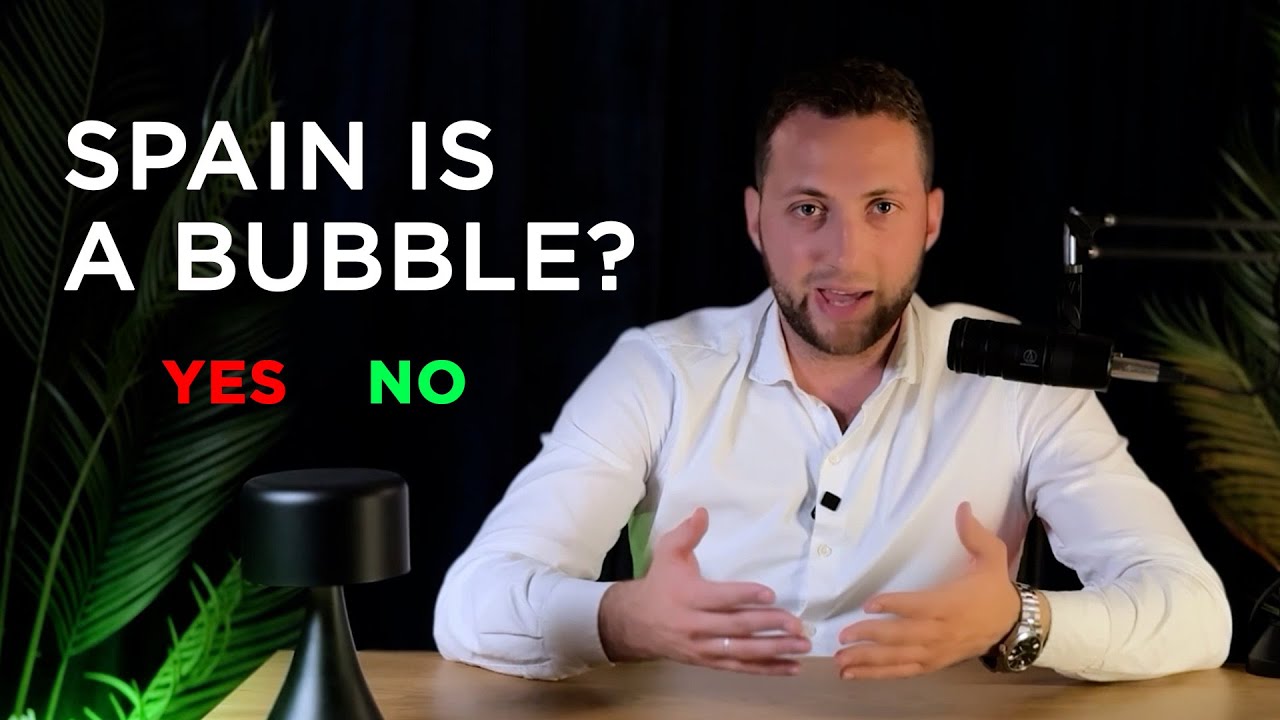
In 2025 I recorded a video asking whether the Spanish market was a bubble. At the time the mood was still euphoric and the question sounded pessimistic. The numbers arriving now are close to what I described then: not a crash, but a market that stops rewarding sellers who price on hope.
Too much money went in, and prices never came back down
The simplest explanation for where we are is the honest one. Enormous amounts of money moved into Spanish property over the last few years. Cheap financing, post-pandemic relocation, foreign capital looking for somewhere stable and sunny. Prices rose because demand genuinely rose.
What has not happened is the correction in expectations. Money slowed down. Asking prices did not. In most cases I now see, owners are holding a number that was realistic in a hotter market and is simply not what a buyer will pay today.
That gap — between what an owner wants and what the market can actually pay — is the single thing driving almost every story you read about the Spanish market right now.
Everyone says supply shortage. That is the wrong diagnosis
You will read everywhere that Spain has a supply shortage. In the raw sense there is truth in it — not enough new housing is being built, and in the best locations there is genuinely nothing left to build on.
But that is not what is happening on the ground, and it is not why a buyer struggles to find something today.
«It is not a shortage of properties. It is a shortage of good properties at a realistic price.»
There is plenty of stock. Walk any portal and you will find hundreds of listings in Marbella and thousands on the Costa Blanca. What is scarce is the overlap between a property worth owning and a price a serious buyer will actually sign for.
Overpriced stock is not supply. It is decoration. It sits on the portal for a year, collects price reductions in public, and teaches every buyer who sees it that the seller is not serious. The portals look full. The real market is thin.
Flippers, taxes, and why new build is getting harder
There is a second mechanism pushing prices up that almost nobody writes about, and it has nothing to do with anyone wanting to live in the property. It is the purchase tax.
A property is bought, held briefly and resold. The buyer pays seven to ten per cent in transfer tax and costs. When they sell, they are not willing to take a loss, so that tax goes into the next asking price. The next buyer pays the same taxes again and does exactly the same thing. Every turn of the same property adds another layer of tax to its price, and none of it makes the property one bit better.
That is not value. It is friction being priced as if it were value. In a market with a lot of short-hold resales — and this coast has plenty — prices ratchet upward on their own, with nothing underneath them.
On the new-build side the problem runs the other way and ends in the same place. Plots in the locations people actually want are close to gone. Construction costs have risen hard and are still rising. But new-build prices cannot simply climb to cover it, because buyers have a ceiling and across most of the coast we are already at it.
So the squeeze lands on the developer's margin. Building is a genuinely risky business: costs can rise mid-construction by enough to eat the entire margin on a project that looked sound on paper eighteen months earlier. The thinner the margin, the less reason anyone has to take that risk — and a developer who loses money on one scheme does not start the next one.
That is the real supply story, and it is not the one you are being sold. Not a shortage that justifies paying anything today, but a pipeline getting thinner because the economics of building have stopped working, next to a resale market inflating itself through tax on tax. Neither is a reason to overpay. Both are reasons to be far more careful about what you buy and at what price.
The market is not dead. It is selective
This is the part that gets lost in the headlines. A correctly priced property in a good location still sells, and it sells quickly. I see it every month.
Our own numbers tell the story better than any index. Across our companies we closed fewer transactions than in the previous period — but the average sale value per property went up. Fewer deals, bigger deals. That is not a dying market. That is a market that has stopped rewarding the middle and started rewarding quality and correct pricing.
If your property is right and your price is right, you are not in a difficult market at all. If your price is a number you decided on in 2023, you are.
Marbella is repricing faster than Torrevieja
Running businesses in both places gives me a comparison most agents do not have, and the difference is clear.
In Marbella, owners are coming to terms with reality faster. Sellers here are more often international, more often advised, more often holding the property as an asset rather than a home. When the market tells them a number, they adjust. Repricing is visibly happening across the resale stock.
In Torrevieja and along the Costa Blanca, owners are holding their prices much longer. The seller profile is different — more private owners, more emotional attachment, less exposure to professional advice. The adjustment is coming there too, it is simply slower.
Same country, same year, two completely different speeds. Anyone telling you “the Spanish market” is doing one single thing has not looked at both coasts.

Why you are being told to hurry
There is a reason the supply shortage story is repeated so often by people in my industry. Scarcity creates urgency, and urgency closes deals. If a buyer believes there is nothing left, they stop negotiating. If a seller believes a shock is coming, they list today.
I understand the incentive. I do not think it serves you.
The truth is less dramatic and more useful: conditions for a disciplined buyer are the same as they always were. You can negotiate. You can wait for the right property instead of the available one. You can walk away. None of that has been taken from you by the market — only by the story you are being told about it.
What this market actually asks of you
- —Negotiate. The gap between asking and achievable is wider than it has been in years. That gap is yours to claim.
- —Be selective. There is no shortage of listings. There is a shortage of good ones. Wait for the right property rather than the one in front of you.
- —Check the price against reality, not the asking price. What did comparable properties actually sell for, not what are they listed at.
- —Choose an advisor by what they decline. Someone who will tell you not to buy something is worth more than someone who will sell you anything.
If you are selling
The hardest conversation I have is with an owner whose number no longer exists. It is not a pleasant message and plenty of agents avoid giving it, because telling a seller what they want to hear is how you win the listing.
I would rather lose the instruction than waste a year of your life. A property priced correctly moves. A property priced on hope collects reductions in public and ends up selling for less than it would have done if it had been honest from the start.
Before you invest in Spain, talk to someone who will tell you no
We advise across both markets — Marbella and the Costa del Sol, and Torrevieja, Alicante and the Costa Blanca. They behave differently, they are at different points in the same cycle, and what is a good purchase in one is often a poor one in the other.
What we actually do is tell you what is worth buying and what is not. Sometimes that means telling you the property you fell in love with is twenty per cent over what it is worth, or that the area you picked will not do what you want it to do over ten years.
If you are thinking about buying in Spain in 2026 or 2027, speak to us before you commit to anything. A conversation costs you nothing. The wrong purchase costs you for a decade.
Thinking about buying in Spain?
If you are interested in buying in Spain, in off-market property, or in investing in Marbella, write to me directly. I will tell you honestly whether what you are looking at is worth the money.
WhatsApp: +34 688 253 213
Email: vadim@abarzo.com
Thinking about selling?
Talk to us before you list. One property at one correct price, properly presented, consistently achieves more than the same property sitting with ten agents at ten different numbers. The moment a buyer sees three prices for one home, the lowest one becomes your ceiling and your negotiating position is gone.
We price to the top of what the market will genuinely pay, and then we defend that number. That is a different job from putting a figure on a portal and waiting.

'/%3e%3c/g%3e%3c/svg%3e)
'/%3e%3c/g%3e%3c/svg%3e)
'%3e%3cpath%20id='Vector'%20d='M27.5646%202.66147L0.985975%2012.9638C-0.0835844%2013.4435%20-0.445347%2014.4044%200.727416%2014.9258L7.54603%2017.1039L24.0324%206.86228C24.9326%206.21931%2025.8541%206.39077%2025.0612%207.09803L10.9016%2019.9848L10.4567%2025.4385C10.8687%2026.2806%2011.6231%2026.2845%2012.1042%2025.866L16.0217%2022.1401L22.731%2027.1901C24.2893%2028.1174%2025.1372%2027.5189%2025.4724%2025.8193L29.8731%204.87385C30.3301%202.78171%2029.5508%201.85992%2027.5646%202.66147Z'%20fill='var(--fill-0,%20%23D9C8B0)'/%3e%3c/g%3e%3cdefs%3e%3cclipPath%20id='clip0_176_19508'%3e%3crect%20width='30'%20height='30'%20fill='white'/%3e%3c/clipPath%3e%3c/defs%3e%3c/svg%3e)
'/%3e%3c/g%3e%3c/svg%3e)